
Why Men Stay Silent, and Who Pays The Price!
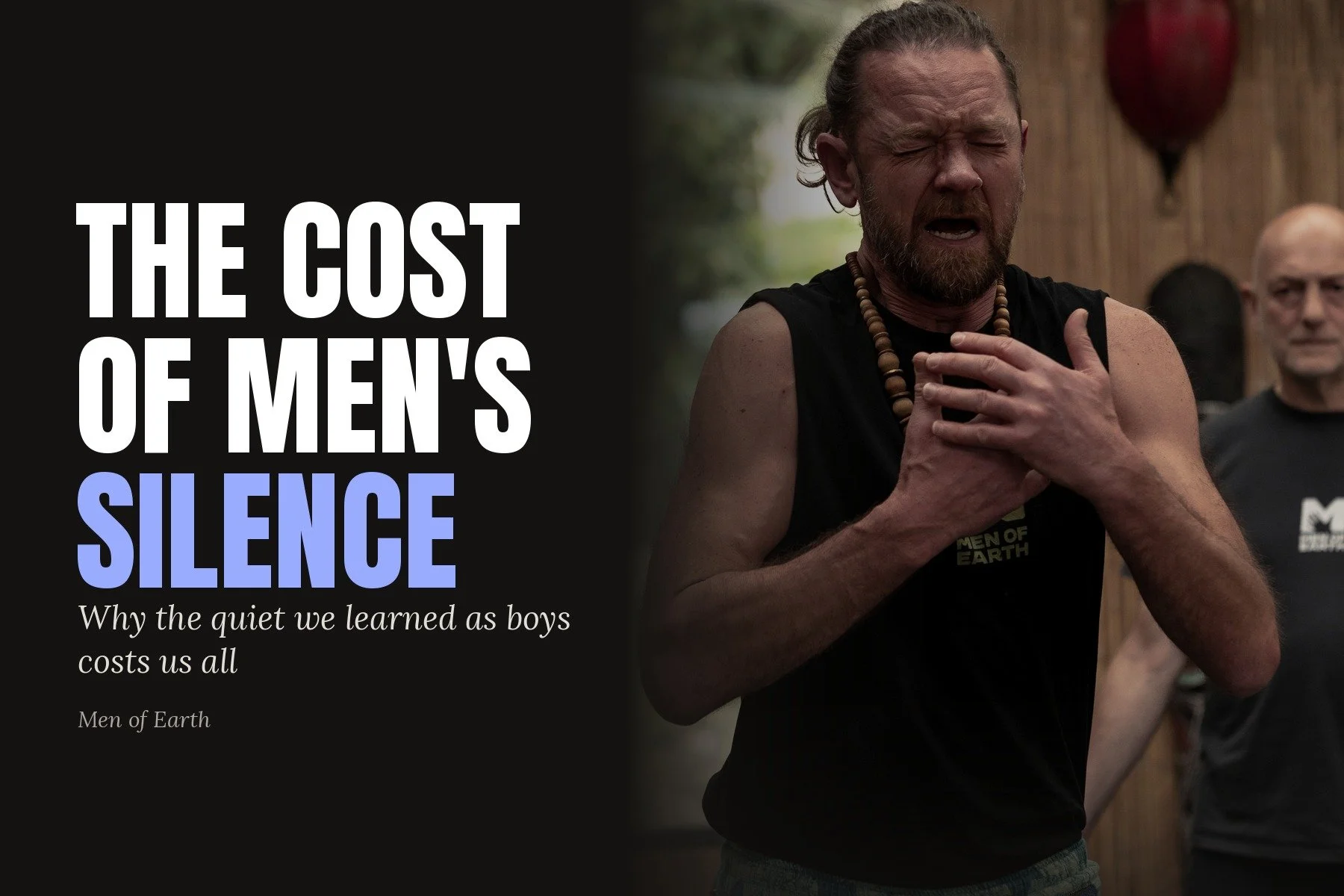
The Cost of Men's Silence
8 Oct 2026 · @Chris
Men's silence affects far more people than we realise.
Most of us learned to stay quiet long before we understood why. We learned it on the playground, in the changing room, around the dinner table and in the group chat. Nobody sat us down and taught it to us. We simply absorbed it, the way boys absorb everything about what it means to be a man.
This piece is about where that silence comes from, what it protects, and who ends up paying for it. It is also about what becomes possible when we finally choose to speak.
We were taught who not to be
Most of us were never shown how to be a man. We were mostly shown what we shouldn't be.
The guidance rarely came as encouragement. It came as warnings, jokes and put downs. Don't cry. Don't be soft. Don't be a girl. Every one of those lines carried the same message: if you show this part of yourself, you will be laughed at, pushed out, or made small.
We heard these words so often growing up that, in time, they became the voice in our own heads. The fathers, coaches and mates who said them no longer needed to be in the room. We had learned to police ourselves, and shame did the teaching.
Silence became the price of belonging
Shame makes us a quiet offer. Keep your mouth shut and you get to belong.
So we stayed quiet. We laughed along when something didn't sit right. We kept our struggles to ourselves. It kept us in the group, and being in the group felt like safety.
For a boy, that trade makes perfect sense. Belonging matters more than almost anything. But many of us carried that same trade into adulthood without ever stopping to ask what it was costing us, or the people around us.
Who pays for our silence
The silence that kept us safe has left women and children feeling less safe.
When we let a comment slide, laugh at the joke that goes too far, or look away from behaviour we know is wrong, men who cause harm learn something important. They learn that no one will stand in their way.
Most of us would never hurt anyone. That matters. Yet our silence can still protect the spaces where harm happens. Not doing harm ourselves is not the same as refusing to make room for it.
The loneliness inside the silence
Here is the part we rarely talk about. The safety we found in silence was never really safety. Underneath it, many of us were deeply alone.
The silence that stops us speaking up for others is the same silence that stops us saying "I'm not okay." It is one habit, not two. A man who has learned that speaking up costs him belonging will stay quiet when a mate crosses a line, and he will stay quiet when he is the one who is struggling.
So we carry our grief, our fear and our pain on our own, because somewhere along the way we learned that reaching out was weakness.
One system, two kinds of harm
The same culture that leads some men to harm women leads many more to harm themselves.
Patriarchy teaches men to control the world around them while cutting off the world within them. Outwardly, it rewards dominance and toughness. Inwardly, it asks us to shut down feeling, need and tenderness until we barely know they are there.
These are not separate problems. They grow from the same root, and they are kept alive by the same silence.
It doesn't have to stay this way
None of us chose the culture we grew up in. But each of us gets to choose what we do with it now.
It takes courage to speak up when a mate crosses a line, and to stay steady when the room goes quiet and it feels uncomfortable. It takes courage to let yourself be seen, to say "I'm struggling" out loud, and to let other men do the same without making them pay for it.
That courage is what turns a good man into a whole one. It rarely starts with a grand gesture. More often it starts with one honest conversation.
It's not your fault. But it is your responsibility.
If this landed with you, send it to a man who needs to hear it.