
The Missing Adam's Apple: Fact, Myth and Why Everyone's Talking About It
Nov 05, 2026
Look at photos of men from the 60s and 70s. Adam's apples everywhere.
Today you barely see them.
So the question is doing the rounds online: where did they go?
Is the Adam's apple really disappearing?
The honest answer is that we don't know yet. One caveat before we start: the Adam's apple hasn't actually gone anywhere. Every man still has the cartilage that makes it. The real question is whether it has become less visible, and why.
Carrying more than anyone knows? This short quiz will point you to the right place to start.
What the Adam's apple actually is
At puberty, testosterone enlarges the larynx and narrows the angle of the thyroid cartilage to around 90 degrees in men. In women it's closer to 120.
That angle is the bump.

Photo: ROCKETMANN TEAM on Pexels
So the Adam's apple is tied to testosterone, and that link is why people have started reading so much into it.
Why it's getting so much attention
"It spreads online because it fits a bigger story about men changing."
Chris Geisler
Four things are driving it.
- It's easy to show side by side. You don't need a study, only two photos. One write-up of the trend describes a YouTube video comparing a young Clint Eastwood with Timothée Chalamet.
- It fits the testosterone conversation. T-maxxing, trying to push testosterone up by natural or artificial means, is now a social media trend. A urologist told Newsweek that testosterone has become a "proxy for masculinity and vitality". A neck you can see makes that proxy visual.
- Looksmaxxing has made necks a topic. Looksmaxxing is about maximising physical appearance, and that crowd care a lot about how male a neck looks.
- It comes with a villain. The same write-up describes a viral TikTok blaming atrazine, a US herbicide. It found no evidence linking atrazine, or any single cause, to smaller Adam's apples.
What might explain it
Thicker necks, gym culture and beards. This is the obvious answer: they hide it. It's the simplest explanation, though we couldn't find anyone who has tested it.
The photos themselves. The photos that spread are the ones that make the point, so they aren't a fair sample.
Age. A 2023 study of neck scans from 210 adults found the cartilage got bigger and the angle tighter in older men. So a side-by-side of an older man and a younger one may not show what it seems to.
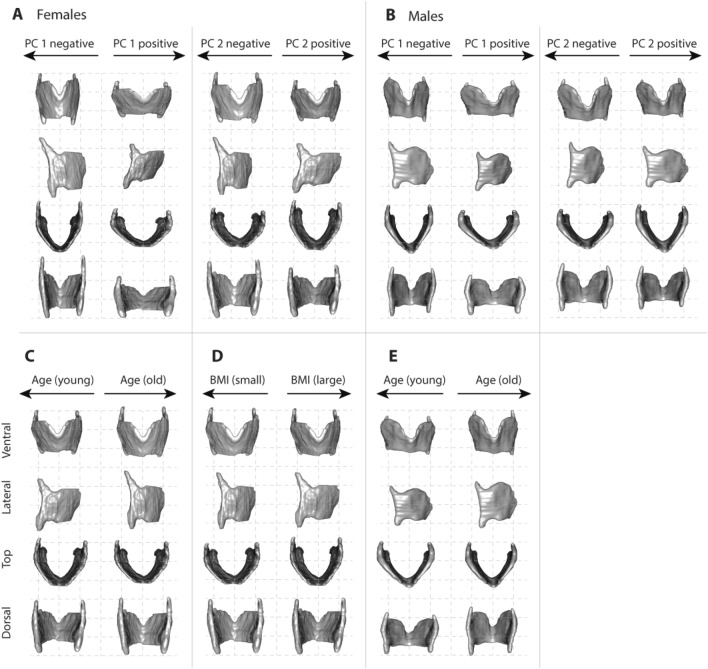
How thyroid cartilage shape varies in women and men, and how it shifts with age and BMI. Figure 3 from Riede et al., Scientific Reports, 2023, used under CC BY 4.0.
What we don't know
- Larynx size across generations. We couldn't find a single study that has measured it, and neither could that write-up. Without that, nobody can say the larynx itself has changed.
- Whether testosterone explains it. Studies do suggest men's average testosterone has fallen in recent decades. A study of older men in Boston found a drop that was independent of age, and a US study of younger men found one too. But both are American, neither goes back to the 60s, and neither looked at the larynx.
- Whether chemicals play a part. Some researchers link endocrine-disrupting chemicals to changes in male development. The animal evidence is stronger than the human evidence, which is mixed, and nothing yet ties this to the larynx.
Fact or myth?
We don't know yet.
The falling testosterone figures have research behind them. The disappearing Adam's apple, so far, has only photos.
If you're worried about your health or your hormones, that's a conversation for your GP, not a neck photo.
Want more like this? Get Midweek Medicine straight to your inbox.
Related posts
FREE GUIDE: SHADOW WORK 101
A practical introduction to recognising the patterns shaping your reactions, relationships and choices.
Free. Straight to your inbox. Unsubscribe any time.
